Playgroup vs Nursery in Chennai: what’s the difference?
Play Group, Nursery, LKG, UKG — every preschool uses the same labels, and every parent has the same question: what’s actually different between them, and how do I know which one is right? Here’s the short answer, in plain English.
Quick comparison
| Stage | Age | Main focus |
|---|---|---|
| Play Group | 2–3 yrs | Settling in, sensory play, first friendships |
| Nursery | 3–5 yrs | Themes, colours, shapes, early vocabulary |
| Lower KG | 4–5 yrs | Letters, numbers, early reading |
| Upper KG | 5–6 yrs | Full pre-big-school readiness |
Play Group (2–3 years): saying goodbye, without tears
Play Group is usually a child’s first time away from a parent in a structured setting. Academic outcomes are not the point. The goals are much simpler, much more important:
- Feeling safe with an adult who isn’t Mum or Dad.
- Getting comfortable with routines — circle time, snack time, story time.
- Noticing other children exist, and starting to play alongside them.
- Developing the fine motor skills needed later (holding crayons, stacking blocks, pouring water).
If your child is 2½ and still mostly plays alone, that’s normal. Play Group gently builds the bridge.
Nursery (3–5 years): curiosity takes off
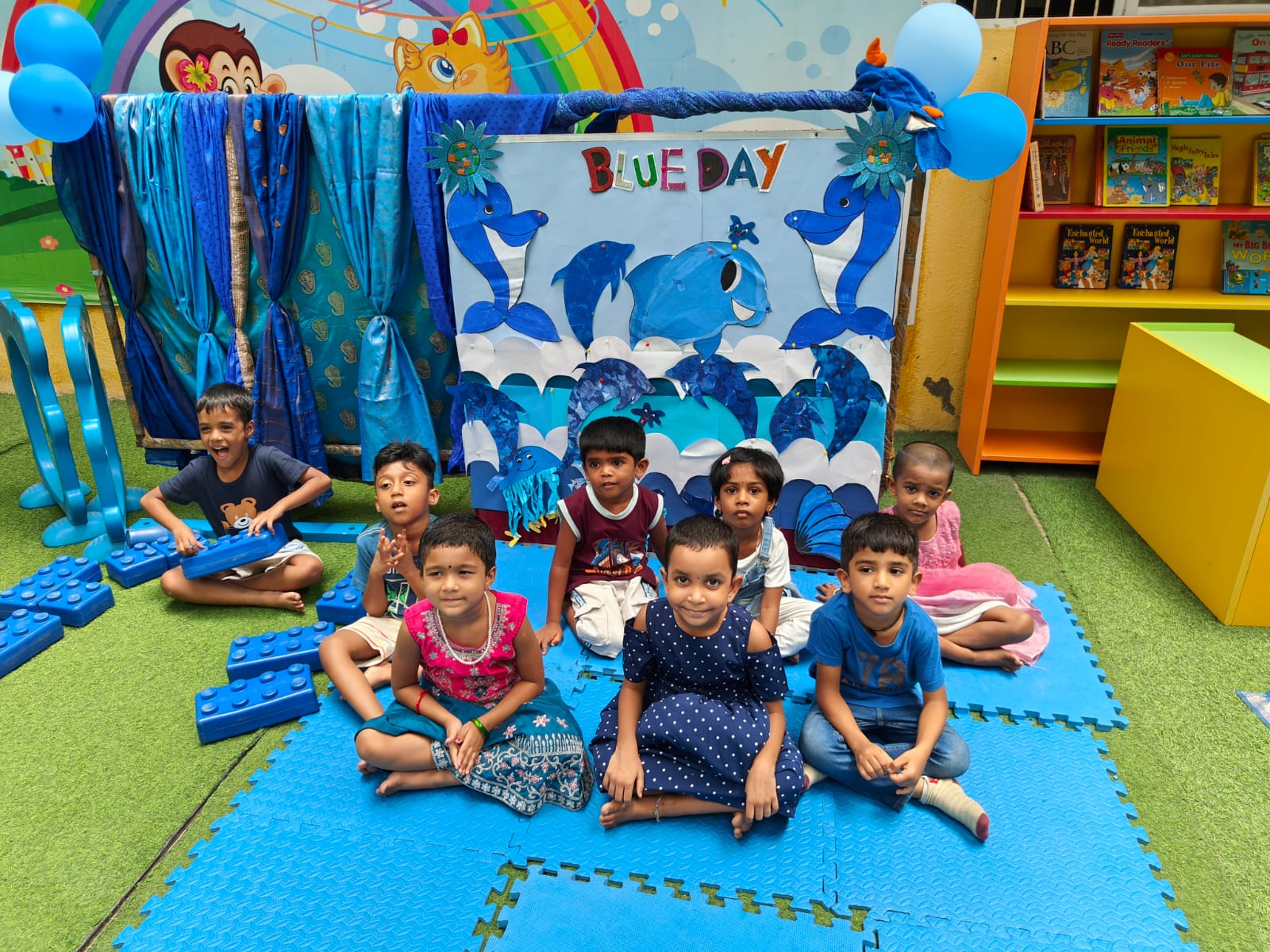
Nursery children love naming things. Colours, shapes, animals, letters, numbers — everything gets labelled and repeated. This is the stage where theme-based learning really works: a week on “the sea”, a week on “our family”, a week on “things that grow”.
A good Nursery class isn’t about drilling the alphabet. It’s about exposing children to rich vocabulary in fun contexts so that words, numbers and ideas become familiar friends by the time Lower KG begins.
Lower KG (4–5 years): letters meet sounds
Lower KG is where pre-reading really begins. Children learn phonics — the sounds that letters make, not just their names. They write their own names. They count meaningfully. They start hearing stories and predicting what happens next.
Socially, LKG children often have best friends — sometimes a different one each week — and start negotiating turn-taking in more complex ways. Conflict resolution is a huge part of what’s being taught, quietly.
Upper KG (5–6 years): ready for big school
Upper KG is a bridge year. By the end of it, children should be able to sit through a 20-minute focused activity, read simple words, write their first name, count to 50 or more, and — most importantly — want to go to school.
The best Upper KG classes deliberately mirror big-school routines (lunchbox, uniform, bell times) while still letting children be children. Overdo the academics and you’ll have a burnt-out 6-year-old on your hands.
How do I know my child is ready?
Readiness isn’t about age — it’s about three things:
- Can they be away from me for 3–5 hours without breaking down?
- Can they manage basic self-care — eating, washroom, shoes?
- Do they show curiosity when they see other children playing?
If the answer is “mostly yes”, your child is ready for the age-appropriate stage. If it’s “not really,” wait a term. Early-years education is not a race.
The difference between Play Group, Nursery and LKG isn’t worksheets. It’s how much of the world a child is ready to hold in one day.
What iPlay iLearn does differently
Every stage at iPlay iLearn is built around the same principle: children learn what they love. We run four age-graded programs with small ratios, our own I EPICS curriculum, and teachers who have been with us for years — which means your Nursery teacher knows exactly what your Play Group teacher built with your child.
Not sure which stage fits?
Come visit us. Bring your child. We’ll watch them play for 20 minutes and tell you honestly what we think.
Book a visit →