Bilingual at home: raising a child who loves both Tamil and English
“Will my child learn English if we speak only Tamil at home?” “Will he forget Tamil if everything at school is in English?” The short answer to both: no. Here’s the fuller answer, with what Chennai parents should — and shouldn’t — do from age 2 onwards.
What the research actually says
Children aged 0–6 can fluently acquire two languages at the same time, in parallel, without confusion. Multiple studies (the Harvard Graduate School of Education, the Cambridge bilingualism project, and India’s NCERT) have converged on this. Bilingual children may start speaking a few weeks later, but they pull ahead on flexibility, attention and problem-solving by age 6.
The one-parent-one-language myth
You don’t need rigid rules like “Amma speaks only Tamil, Appa speaks only English.” That works in some families but isn’t necessary. What works is consistency within context: Tamil in the kitchen, English during bedtime stories, for instance. Children pick up the pattern fast.
Why preschool is the sweet spot
At home, most Chennai children hear Tamil primarily. At an English-medium preschool, they hear English for 3–4 hours. This is almost perfectly balanced. By Upper KG, most of our children:
- Speak fluent Tamil at home
- Understand and speak functional English at school
- Can switch mid-sentence without confusion
Five things parents should do at home
- Keep the mother tongue rich. Read Tamil storybooks, sing Tamil songs, have grandparents speak to the child in Tamil. Strong first language is the foundation for every other language.
- Don’t “correct” the mixing. “Amma, I want water-ku.” This is perfectly healthy bilingual behaviour at age 3. Do not correct it. It goes away naturally by age 5.
- Pick one English-medium input. Preschool alone is often enough. You don’t need English TV + English apps + English books if the family doesn’t speak English at home.
- Read together, both languages. Five minutes of Tamil book, five minutes of English book. Bedtime is the best time.
- Praise the mother tongue explicitly. “I love how you told that story in Tamil!” A child notices where praise lands and will hold on to that.
Three things NOT to do
- Don’t stop speaking Tamil at home thinking it helps English. It doesn’t. It weakens both languages.
- Don’t push English-only flashcards on a 2-year-old. Let play and conversation do the work.
- Don’t panic if the child refuses one language for a week. It’s a phase. Keep exposure going, don’t force output.
A bilingual child is not two monolinguals in one body. They are building a unique, integrated language system. Trust the process.
What we do at iPlay iLearn
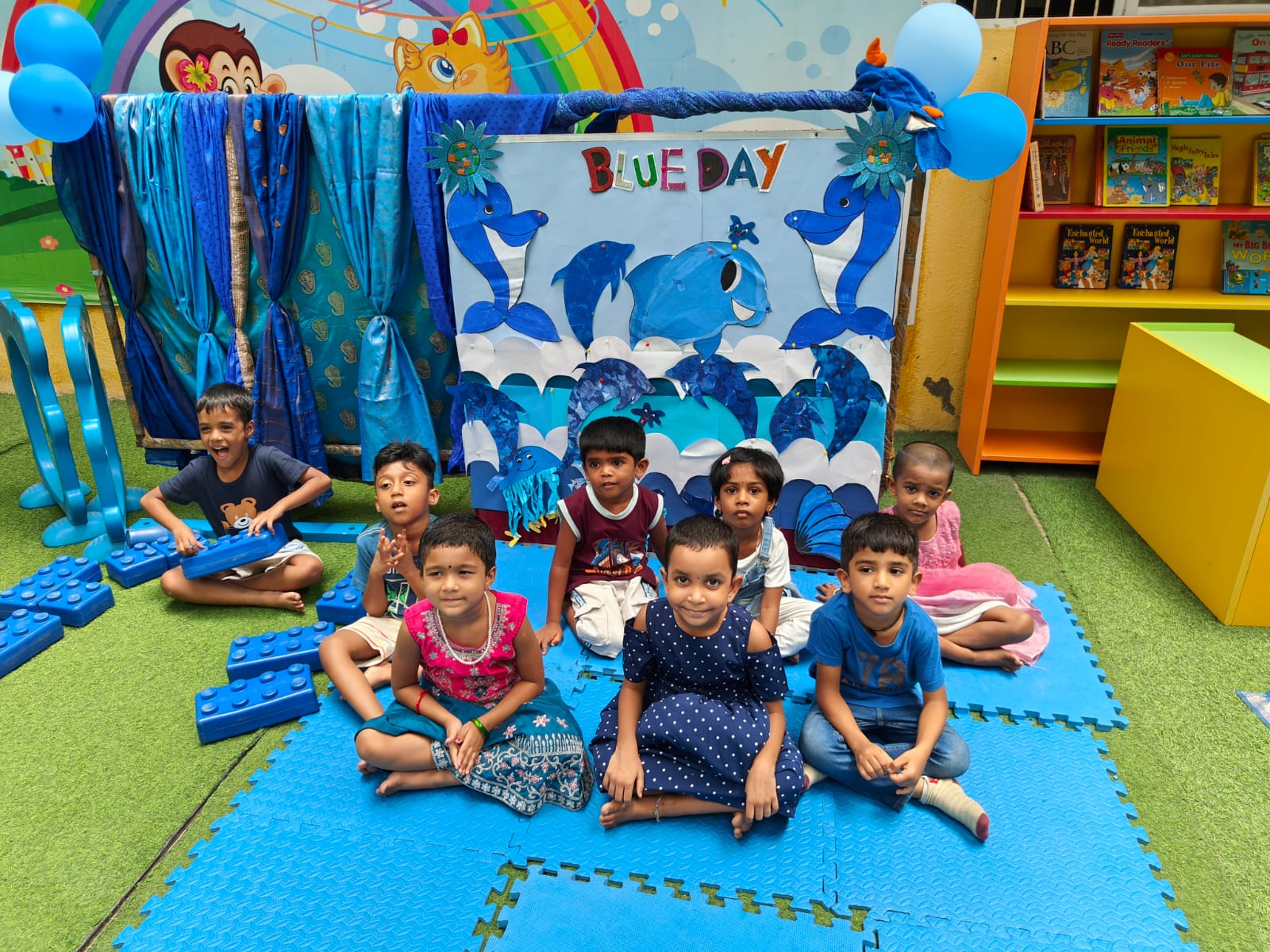
Circle time is in English. Storytime alternates Tamil and English. Songs rotate — Pongal songs in Tamil, Christmas carols in English, universal nursery rhymes in both. Children absorb it all. By UKG, it’s invisible which language each child uses first.
See how this fits into our broader approach in the I EPICS curriculum guide.
A classroom that lives in two languages
Come see a story session at iPlay iLearn — in Tamil and English on the same morning.
Book a visit →